
Electric toothbrush choices for precise cleaning and battery performance
What if precise brushing depends less on choosing electric or manual and more on reaching the gumline and back teeth? An electric toothbrush for precise cleaning uses powered movement to help sweep bristles across tooth surfaces, while a manual brush relies on your hand to guide each stroke. Either way, technique matters.
Before changing your routine, weigh cleaning performance, convenience, and battery life. This guide explains how electric toothbrushes work and compare with manual brushes, so you can choose an option that suits your needs while keeping the basics of gum care in view.
You’ll learn which features can support a thorough routine, how battery performance affects daily use, and what to consider when comparing toothbrush types. We’ll also cover simple habits for cleaning along the gumline and reaching difficult areas, because the most useful toothbrush is one you can use consistently and effectively.
Key Takeaways
- Choose a toothbrush you can use comfortably and consistently; powered features can support brushing, but they don’t replace careful technique.
- Compare useful features such as timers, pacing alerts, and pressure sensors, while considering how the battery or charging routine fits your day.
- Give extra attention to the gumline, spaces between teeth, back molars, and other areas that are easy to miss.
- Build a steady routine with thorough brushing and interdental cleaning, and replace brush heads when they become worn.
- For braces or implants, explore a portable toothbrush designed for those needs as one option in your daily oral-care routine.
Why It Matters
A clean-looking smile doesn’t always mean every tooth surface has been reached. Plaque can collect along the gumline, between teeth, and around back molars, where bristles may miss if they pass over too quickly. Regular, careful brushing helps disrupt this sticky film before it builds up. The goal isn’t to scrub harder, but to guide the bristles deliberately across the areas that need attention.
Gum health is a key part of that effort. Plaque left at the gumline can irritate surrounding tissue and contribute to inflammation. Gums may become tender, swollen, or prone to bleeding. These signs deserve attention, especially if they persist, but they don’t identify a specific condition on their own. A dental professional can assess ongoing changes and advise on appropriate care.
Oral health is also part of the wider picture of well-being. Research is exploring links between oral health and health elsewhere in the body, but an association doesn’t prove that one directly causes the other. Keeping your mouth clean remains a practical part of looking after yourself, alongside regular dental care and everyday habits that support general health.
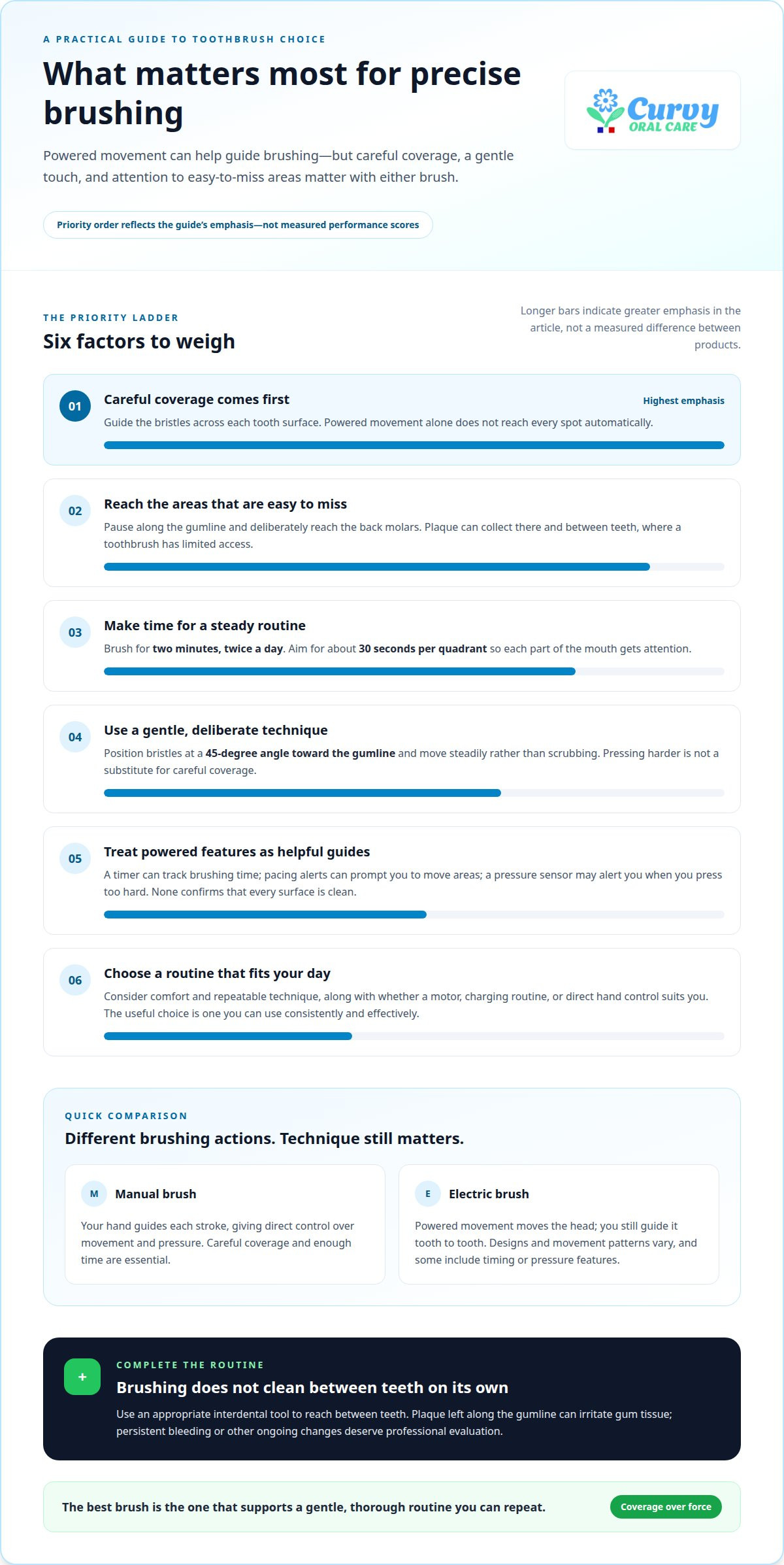
- Spend enough time: Brush for two minutes twice a day, giving each quadrant of the mouth about 30 seconds.
- Be deliberate: Pause at the gumline, back teeth, and other areas that are easy to rush past.
- Use a gentle touch: Pressing harder isn’t a substitute for covering each surface carefully.
An electric toothbrush for precise cleaning may make a consistent brushing pattern easier to follow, but powered movement alone won’t reach every spot automatically. A manual brush can also clean thoroughly when you guide it carefully. The useful choice is the one that helps you maintain a comfortable routine and attend to less-visible areas, not simply the one with the most features.
Make brushing more purposeful by slowing down, working methodically around your mouth, and noticing whether you’re neglecting the gumline or back molars. Clean between your teeth as well, and keep regular dental visits in your prevention routine. Consistent attention supports healthy gums and a cleaner mouth without making daily care complicated.
The Science
Electric and manual toothbrushes differ mainly in who supplies the brushing action. With a manual brush, your hand guides every stroke. An electric model moves its head with powered motion, which may oscillate or follow another pattern. Designs vary, so “electric” doesn’t describe just one brushing action.
That difference can change how brushing feels, but it doesn’t make technique optional. With either type, place the bristles near the gumline and work across each tooth surface. A 45-degree angle toward the gumline helps position bristles at this boundary. Move steadily rather than scrubbing, and give extra attention to back molars.
Some electric models include a two-minute timer, pacing alerts, or a pressure sensor. A timer helps track a complete session, while pacing prompts can remind you to move to another area. A pressure sensor may alert you when you press too hard. These features guide your brushing, but they don’t confirm that every surface is clean.
Manual brushes offer direct control over pressure and movement, without a motor or charging routine. Their effectiveness depends on careful coverage, a gentle touch, and enough time. Electric brushes provide powered movement, but you still need to guide the head methodically. Neither option cleans between teeth on its own, so interdental cleaning remains a separate part of oral care.
Read comparisons of toothbrush types carefully: a brush’s movement does not guarantee a particular health result. A useful comparison asks whether the design helps you brush consistently, reach difficult areas, and avoid pressing too hard. Someone who rushes, for example, may value a timer, while someone who prefers hand control may choose a manual brush. Comfort and repeatable technique matter.
Keep your routine gentle and systematic with either brush. With an electric model, let the powered action move the head while you guide it from tooth to tooth. With a manual brush, use small, controlled strokes instead of forceful back-and-forth scrubbing. Choose a routine that feels comfortable and gives each area careful attention.
What Happens in the Mouth
Dental plaque is a soft, sticky film that forms on teeth. It contains bacteria and builds up throughout the day, especially where cleaning is less thorough. The gumline, where each tooth meets the gum, is one place plaque can linger. So are the grooves of back molars and the tight spaces between teeth.
Plaque left beside the gums can irritate the tissue. The body responds with inflammation, which may make gums look red or feel tender. Bleeding during brushing or interdental cleaning is a sign to pay attention to, not a reason to scrub harder. Persistent bleeding deserves professional evaluation, since several factors can affect gum health.
Plaque can also collect between neighboring teeth, where toothbrush bristles have limited access. Brushing only the visible front surfaces leaves these contact points largely untouched. Cleaning between teeth with an appropriate interdental tool helps reach those spaces. A dentist or dental hygienist can advise which option suits the shape and spacing of your teeth.
Back molars need deliberate attention, too. Their position makes it easy to miss the outer surfaces near the cheeks or the inner surfaces toward the tongue. Food debris may also collect in the chewing grooves. Move the brush head around each tooth rather than sweeping quickly across the row, and make sure you reach the last teeth on both sides.
Plaque that remains undisturbed can become harder to remove with ordinary brushing. Hardened deposits need professional cleaning. Daily brushing and between-teeth cleaning help disrupt plaque before it accumulates, while routine dental visits let a professional assess areas that are difficult to inspect at home. The aim is steady prevention, not forceful scrubbing.
Notice your brushing pattern. If one spot repeatedly feels rough or your gums often bleed in the same area, slow down and clean there gently and carefully. Don’t diagnose the cause yourself: discuss persistent bleeding, swelling, pain, or other lasting changes with a dental professional. Healthy gums benefit from attention beyond the tooth surfaces you can see.
What You Can Do
Compare toothbrushes by useful features, battery setup, and replacement-head needs, not by feature count alone. A two-minute timer, gentle pressure guidance, and comfortable handling can matter more than a screen.
Consider ongoing upkeep before choosing. Compare the handle’s purchase cost with replacement-head costs, then check whether the model is rechargeable or uses replaceable batteries. An adjustable intensity setting may suit someone who prefers a gentler feel, while multiple modes help only if you’ll use them. A dentist can help you choose features for specific oral-care needs.
Battery design affects daily convenience. A rechargeable brush needs its charger and a place to charge; a battery-powered model avoids a charging base but needs replacement batteries. For travel, consider the handle’s weight and how you’ll keep it powered. Battery life varies by model and use, so don’t assume every toothbrush lasts the same length of time.
Sonic and Oscillating Features
Sonic toothbrushes use rapid brush-head movement, while oscillating models move a small head back and forth or rotate it. These designs create different sensations and brushing actions. Compare how each feels in your hand, how easily its head reaches back teeth, and whether replacement heads are easy to get. Whatever the movement style, guide the bristles gently across each surface.
Timers, Pacers, Screens, and Apps
A two-minute timer helps you complete a full brushing session; pacing alerts every 20 or 30 seconds can prompt you to move between mouth quadrants. Screens and apps may display brushing feedback or track sessions, but they add little if you ignore the prompts. Choose the simplest guidance that helps you cover each area evenly and brush without pressing too hard.
Modes and adjustable intensity aren’t the same. A mode may change the brush’s action, while intensity settings adjust how strong that action feels. If your gums feel sensitive, a gentler setting may be more comfortable. Check the controls before buying: extra modes can make a handle harder to use without improving your personal routine.
For effective plaque removal, prioritize consistent use, a gentle touch, and brush heads in good condition. Compare replacement availability and charging needs alongside features, then choose a setup you can maintain every day.
Better Daily Oral-Care Routine
Brush twice a day for two minutes, dividing the mouth into four quadrants and spending about 30 seconds on each. Guide the brush head along the gumline, then clean the inner, outer, and chewing surfaces. Slow down around back molars, where a quick pass can miss tooth surfaces.
For braces, implants, or crowded teeth, choose a brush head you can guide carefully around brackets and hard-to-reach edges. A dentist can advise on a suitable brush and cleaning approach for your dental work and tooth spacing.
Repeatedly brushing too hard can irritate gums and contribute to enamel wear. Use gentle pressure, and consider a toothbrush with a pressure sensor if a reminder would help you adjust your technique.
| Option | Guidance | Head and upkeep | Useful for |
|---|---|---|---|
| Electric with timer | Two-minute timer; some models pace quadrants | Replaceable head | Keeping a consistent brushing duration |
| Electric with sensor | Signals excessive pressure | Check replacement-head availability | Building a gentler brushing habit |
| Manual brush | Hand-guided strokes | Replace the whole brush | Direct control without charging |
Choose based on the guidance you’ll use and whether the head reaches your gumline comfortably.
Brush heads vary in shape, cushioning, and bristle softness. A compact head may be easier to maneuver behind the last molars; soft bristles can feel gentler along the gumline. Replace an electric toothbrush head every three months, or sooner if the bristles become bent or frayed.
Estimate ownership over three years by adding the handle cost to replacement-head costs for that period. Then consider whether the handle is rechargeable, repairable, or compatible with replaceable parts. Eco-friendly materials alone don’t establish a lower impact; the full product design and replacement needs matter.
For travel, pack the handle, toothbrush head, and charger if your model needs one. A minute timer or quadrant cue can help you keep the same brushing pattern away from home.
Dentists recommend toothbrushes with a timer, quadrant pacer, and pressure sensor as features. Prioritize prompts that help you brush gently and cover each area; choose simpler controls if extra features distract from your routine.
For a travel-ready brushing setup, choose a sonic toothbrush.
Portable Toothbrush for Braces and Implants
A portable toothbrush can be useful for people with braces or implants. Brackets, wires, and implant restorations can make some surfaces harder to reach, so a routine needs to account for the areas around them. The Curvy Oral Care website is intended for users aged 18 or older.
With braces, guide the brush carefully around brackets and along the gumline instead of focusing only on visible tooth surfaces. Clean above and below each bracket, then include the chewing surfaces and back molars. A toothbrush for braces is one option to consider. Follow your dental professional’s instructions for your specific appliance and any additional cleaning steps.
Implants call for careful brushing around the gumline and the areas where the restoration meets surrounding tissue. Move methodically around each accessible surface, including sides that may be harder to see. A toothbrush supports the brushing part of daily care, while cleaning methods for an individual implant should follow guidance from that person’s dental professional.
Some people prefer powered brushing with a sonic toothbrush. The powered movement does not replace guiding the brush head across individual tooth surfaces. Take care around dental work and crowded areas, and use the approach recommended for your needs. A sonic toothbrush is a tool for the brushing step, not a replacement for professional advice or other parts of an oral-care routine.
Replace brush heads when their bristles become bent or frayed, as worn bristles may be harder to guide with control. Keep your brushing gentle, especially around the gumline and dental work.
Choose a toothbrush that fits your daily habits and helps you reach the areas that need attention. A dentist or dental hygienist can give personalized instructions for cleaning around braces, implants, or other dental work. Dental professionals provide evaluations and individual care guidance.
Make Your Next Step a Practical One
Choose a brushing setup that suits your habits and helps you care for areas you tend to miss. The right electric toothbrush for precise cleaning is one you can guide comfortably and use consistently. Let comfort, access, and how the brush fits into your day shape your choice.
Small routine adjustments can help make oral care more manageable. Notice which parts of your brushing feel awkward, then choose a practical change that supports a steady habit. If you’re planning a setup for home or travel, explore a toothbrush and travel case.
Keep your next step simple and realistic. Consistent care is built one brushing session at a time, with attention to your comfort and the areas that need it most.
Frequently Asked Questions
What features make an electric toothbrush effective for precise cleaning?
An electric toothbrush for precise cleaning should feel comfortable to guide around each tooth and the gumline. A timer can help you complete a full session, while a pressure sensor may remind you to ease your grip. Consider whether its heads are easy to replace and suit your mouth. Features are most useful when they support a routine you can follow consistently, including careful cleaning around back teeth and dental work.
Are oscillating-rotating or sonic electric toothbrushes better for targeted cleaning?
Neither movement style is automatically best for everyone. Oscillating-rotating brushes move their heads back and forth or in a rotating action, while sonic brushes use rapid vibration. Your comfort with the sensation and ability to guide the head around each tooth matter. If you have braces, implants, or sensitive areas, ask your dental professional how to adapt your brushing technique rather than relying on brush type alone.
Which electric toothbrushes have small brush heads for precise cleaning?
Look for a compact brush head that fits comfortably around your back teeth and reaches the gumline without forcing your jaw wide. A small, rounded head may be easier to steer around crowded teeth or brackets than a broad one, though shape and fit vary by model. Check that compatible replacement heads are available. For braces or implants, your dental professional can suggest a head shape suited to your needs.
How do pressure sensors and brushing timers improve cleaning precision?
A pressure sensor can signal when you’re pressing too firmly, helping you use a lighter touch around delicate gum tissue. A timer tracks brushing duration, and quadrant pacing prompts can remind you to move through different parts of your mouth. These tools provide cues, not a map of every cleaned surface. For example, a timer won’t notice if you routinely skip the inner surfaces of your lower teeth.
How much do electric toothbrushes for precise cleaning cost in the United States?
Electric toothbrush prices in the United States vary with features, construction, power source, and included accessories. Ongoing costs also depend on compatible replacement heads and how often you replace them. Compare a handle’s features with the upkeep involved instead of choosing by its feature list alone. For a fair comparison, consider the whole routine, including charging or battery needs and replacement-head availability.
How should you use an electric toothbrush to clean each tooth precisely?
Divide your mouth into four areas and work through them in sequence so none gets rushed. Hold the brush head gently against each tooth, pausing over the outer, inner, and chewing surfaces. At the front teeth, tilt the handle vertically to reach their narrow inner surfaces. Follow your toothbrush’s instructions, and don’t use force to compensate for an area that feels difficult to reach.
How often should electric toothbrush heads be replaced, and what do replacement heads cost?
Replace an electric toothbrush head every three months, or sooner if its bristles become bent or frayed. Replacement-head costs depend on the model, compatible head type, and pack size, so compare ongoing costs alongside the handle. Heads aren’t interchangeable across every toothbrush. Confirm compatibility with your handle before buying, and replace a worn head promptly so you can guide its bristles effectively.

Article by
Aline Peixe Nebot
Aline Peixe Nebot is a Veterinarian and passionate advocate for better oral health, committed to raising awareness of oral health as a matter of public health. She actively promotes the importance of simple, effective oral care routines and works to educate the public about the often-overlooked link between oral health and overall systemic health. Her mission is to make better oral care knowledge accessible to everyone and encourage healthier habits for life.
Disclaimer
Disclaimer: The information provided in this article is intended for general educational and informational purposes only. It is not intended to replace professional medical, dental, or healthcare advice, diagnosis, or treatment.
Some content may be AI-assisted and is provided to support health education and awareness. While we strive to share accurate and up-to-date information, health recommendations and scientific evidence can evolve, and the information presented may not apply to every individual.
The connection between oral health and overall systemic health is an important and developing area of research. Associations discussed in this article should not necessarily be interpreted as proof of cause and effect.
Always consult a qualified dentist, physician, or other healthcare professional regarding your individual health, symptoms, medications, or treatment decisions. Do not delay or discontinue professional care based on information presented in this article.
This content is for education and awareness—not diagnosis or treatment.